Atlantic Canada · Pilot in development
Atlantic Canada needs a voice in the age of AI.
The Atlantic AI Policy Fellowship is a proposed regional fellowship developing the people, research and policy capacity needed to navigate the opportunities and risks of advanced artificial intelligence.
Artificial intelligence will increasingly shape how governments deliver services, how industries compete and how communities adapt.
But its effects will not be geographically uniform.
Policy designed for Toronto, Ottawa, Washington or London will not automatically answer the questions facing Atlantic Canada.
Regional considerations
Atlantic Canada needs the capacity to examine these questions for itself.
Build the capacity here.
Atlantic AI Policy Fellowship
A proposed six-month, part-time fellowship bringing together a small cohort of professionals from across Newfoundland and Labrador, Nova Scotia, New Brunswick and Prince Edward Island.
Fellows would combine structured learning, mentorship and applied research to investigate AI policy questions with direct relevance to Atlantic Canada.
The region should not only respond to AI policy developed elsewhere. It should develop people capable of shaping it.
AI policy insights from inside the region will help regional governments develop stronger policies of their own.
Pilot at a glance
A proposal that is deliberately small, and deliberately specific.
Pilot duration
Fellows
Atlantic provinces
Time commitment
Policy research
Mandate
Regional cohort
One cohort. Four provinces. Shared regional questions.
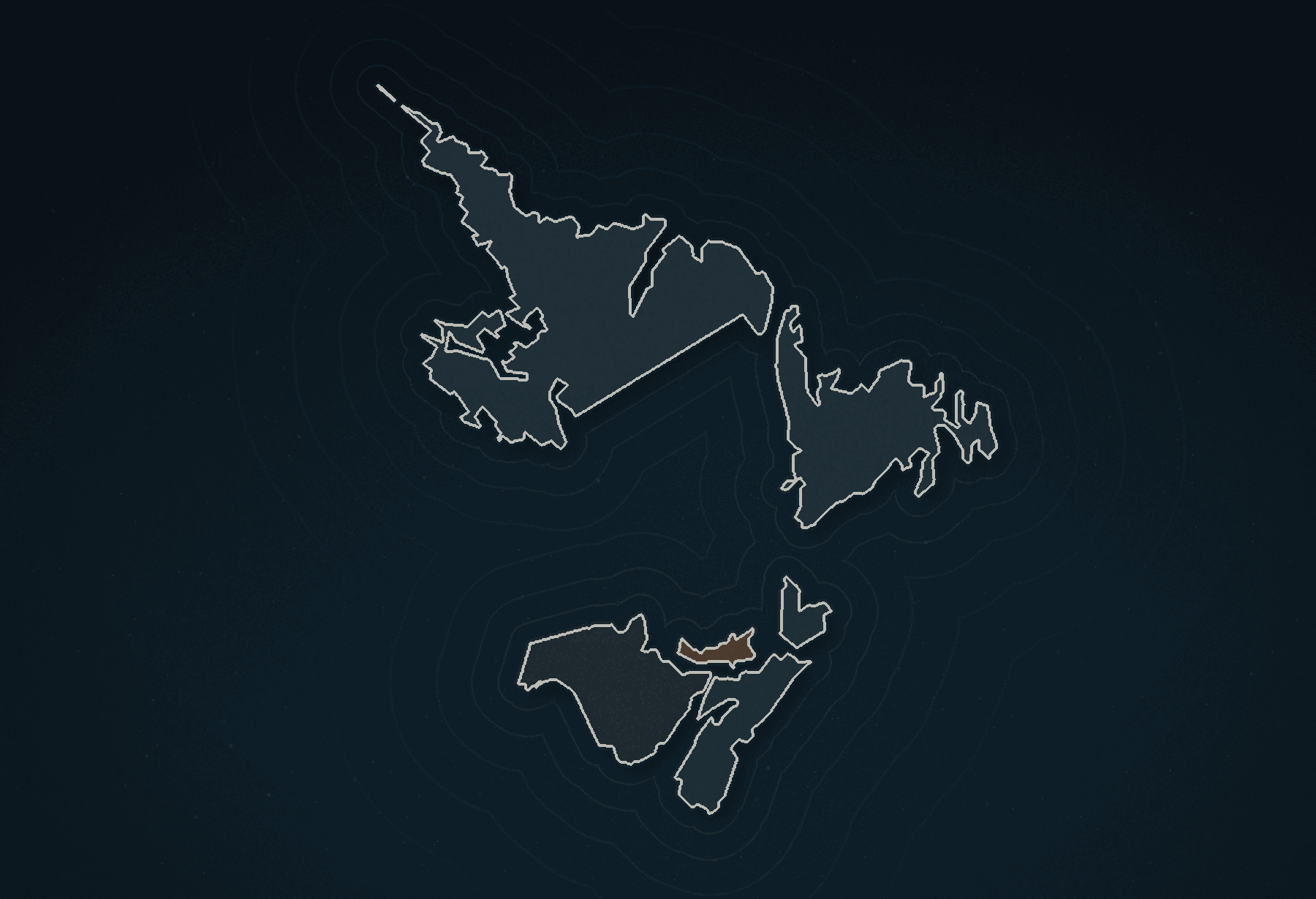
Fellows would remain embedded in their home province while working as a single regional cohort — meeting across borders, comparing notes across sectors, and testing ideas against one another’s context.
NL
Newfoundland and Labrador
NS
Nova Scotia
NB
New Brunswick
PE
Prince Edward Island
What fellows would study
Four proposed thematic areas — not permanent silos.
AI + Oceans
How AI changes fisheries, ocean technology, marine industries, monitoring and the blue economy.
AI + Rural Health
How AI could change access, delivery, workforce models and health systems serving dispersed populations.
AI + Resources
AI adoption, productivity, labour transitions and governance across natural-resource industries.
AI + Data Sovereignty
Governance of AI, data and emerging technologies in partnership with Indigenous communities and institutions.
How the fellowship works
Six months, structured into seven movements.
Foundation
AI governance, technical foundations, public policy, regional context and research methods.
Question
Each fellow defines an applied Atlantic Canadian AI policy problem.
Investigation
Research, interviews, stakeholder engagement, evidence synthesis and policy analysis.
Mentorship
Fellows work with researchers, policymakers, technologists and subject-matter experts.
Policy Lab
The cohort tests ideas together across sectors and provinces.
Publication
Research is translated into credible, accessible policy outputs.
Convening
Findings are presented to policymakers, industry, academia and regional stakeholders.
In practice
A fellowship built around doing, not simply studying.
A typical fellow moves between research, mentorship and cohort work — testing ideas against evidence, and against colleagues from other provinces and sectors.
Why a fellowship
AI policy increasingly requires people who can work across disciplines. The Fellowship would give experienced professionals the time, methods, mentorship and network required to investigate emerging questions before they become urgent policy problems.
What the pilot produces
The pilot is designed to leave work across Atlantic Canada.
People
A regional cohort
A cohort of Atlantic Canadians with deeper AI governance and policy capability.
Research
Applied research
Original applied research addressing regional AI policy problems.
Network
A working network
New connections across government, universities, industry and civil society.
Policy
Policy options
Practical recommendations and policy options available to decision-makers.
Public Knowledge
Public knowledge
Accessible publications, briefings and events that improve regional understanding of AI.
Institutional Model
A tested model
A tested fellowship model that can be evaluated, improved and potentially expanded.
Evaluation
What would make the pilot successful?
This is an experiment that will be measured, not simply a program that will be delivered.
Proposed institutional pathway
Built to become an independent and collaborative policy voice.
The initial Fellowship is being developed as a bounded pilot. It may initially be delivered through a for-profit corporate structure for speed and administrative simplicity, with the intention that a successful model could subsequently transition into an independent not-for-profit organization with appropriate governance, financial oversight and regional representation.
Pilot
Delivered initially through a lean corporate structure for speed and administrative simplicity.
Evaluation
Independent assessment of outcomes, governance needs and regional demand.
Independent institution
A proposed pathway toward a not-for-profit structure with regional governance.
A future governance model would be designed to provide
Funding the pilot
$185,800
Indicative pilot budget · six-month pilot
The majority of pilot resources are intended to support fellows directly and create the research, mentorship and convening infrastructure required for high-quality work.
Fellow stipends
Direct support for the cohort
Expert mentors
Compensation for mentor time
Program delivery
Curriculum, facilitation, coordination
Regional convening / residency
In-person cohort gathering
Research and publication
Editing, design, production
Administration and operations
Program management and overhead
Evaluation
Assessment of pilot outcomes
Detailed pilot budget available for prospective funding partners.
Request the pilot briefPilot timeline
Five phases, moving from design to decision.
Development
- Program design
- Partnership development
- Funding
Launch
- Open fellowship call
- Selection
- Mentor matching
Fellowship
- Orientation
- Research
- Policy labs
- Regional convening
Output
- Publication
- Briefings
- Public presentation
Evaluation
- Pilot assessment
- Program refinement
- Decision on next cohort
Why Atlantic Canada
Four provinces facing many of the same transitions.
The region has distinctive assets and distinctive policy questions. It needs the capacity to connect the two.
Long-term vision
Start with a cohort. Build regional capacity.
Stages beyond the pilot depend on evaluation, partnerships and funding. Expansion is not guaranteed.
Project leadership

Niraj Shukla
Founder & Project Lead
Niraj Shukla works at the intersection of industry, academia and government to advance innovation across Atlantic Canada. He is Director of Intellectual Property Programs at Springboard Atlantic, following a decade with Mitacs, including five years as Regional Director for Atlantic Canada. Previously, he ran and sold a portfolio of small businesses generating millions in annual revenue. He holds an MBA and is doctoral candidate studying technology adoption in vulnerable communities. He has training in AI policy and governance from Oxford and his work spans innovation policy, program design, research and technology commercialization. He actively writes about AI policy at innovationeast.ca
For prospective partners

Get involved
Help build Atlantic Canada’s AI policy capacity.
We are currently speaking with prospective funding partners, institutions, mentors and collaborators interested in helping launch the first Atlantic AI Policy Fellowship pilot.